(Press Reader:WWII lessons critical as repeat of history risked)
On 8 May 1945, British Prime Minister, Winston Churchill, announced the end of the War in Europe with a speech broadcast from Downing Street. He declared a public holiday and Britain and her allies celebrated with great jubilation. Just days before, on 30 April, Hitler had committed suicide in his bunker. It was his chosen way out of a war he’d started but could never win.
Of course, Victory in Europe didn’t mean the end of the world war. This came months later, after the atomic bombing of Hiroshima and Nagasaki when Victory in Japan was declared. The formal surrender ceremony took place on September 2, 1945, six years after the outbreak of World War II.
Countless fiction and non-fiction books, movies and TV series have retold the stories of the Second World War. Too often, the focus has been on heroism but the reality we must never lose sight of is the horrific degradation of humanity, the senseless annihilation of the built and natural environment, and the long-lasting tragic and costly consequences of war.
For six years, the ambition of a crazed dictator and his followers dominated the world. What enabled him to come to power? Why did it take so long for the allies to restore peace in Europe? Why did it take two atomic bombs for the Japanese to surrender? This is the content of academic studies, but the real question is, what can we do to make sure it never happens again?
Well before the outbreak, Hitler’s sabre-rattling and the nature of his brutal regime had raised alarm at the prospect of war. In 1938, his threat to invade Czechoslovakia brought British Prime Minister, Neville Chamberlain, to Nazi Germany. After Chamberlain’s third visit, he returned to Downing Street with an agreement that he claimed promised “peace for our time” in return for Germany annexing Sudetenland – a province in Czechoslovakia.
The following year the agreement was broken. In March, German troops occupied Prague and on 1 September, 1939, the Nazis invaded Poland, causing Britain and France to declare war on Germany. Britain brought with it the whole of the British Empire, thus Britain’s war became our war.
In May 1940, Churchill, who’d been forceful in his criticism of appeasing Hitler, replaced Chamberlain. The lesson was simple: You can’t negotiate lasting peace by attempting to appease a ruthless, power-driven dictator.
It’s an adage, but none-the-less true: If we fail to learn the lessons of history, we are doomed to repeat them. It could be argued that Phil Goff’s role as a diplomat denied him the liberty of asking whether Donald Trump understands this in his attempts to appease Putin with Ukraine territory. Equally, it could be argued that people in positions of authority with the ability to see and understand the lessons of history have a moral obligation to speak out – even if it costs them their job.
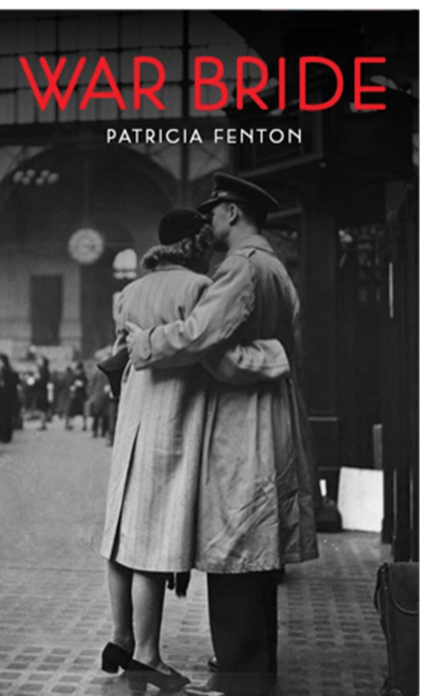
Grim, uplifting and funny, this fictionalised family saga weaves memories and historical records stemming from real-life stories of a Welsh girl and a Kiwi boy who would never have met, if it wasn’t for Hitler.
Evie, born and bred in the Valleys of South Wales, seems destined for a life in service, but the clouds of war draw her to Cirencester and work in a munitions factory. There she meets Frank, a boy from the Bay of Plenty, who is stationed with the 11th Forestry Company of the NZ Army. As war swirls around them, they find themselves in London, a young couple with everything to live for but with death their constant companion.
Publisher: Heritage Press https://heritagepress.nz/ ISBN: 978-1-991163-05-9 RRP: $39.99 Available from Heritage Press in print and ebook, and in bookshops throughout NZ
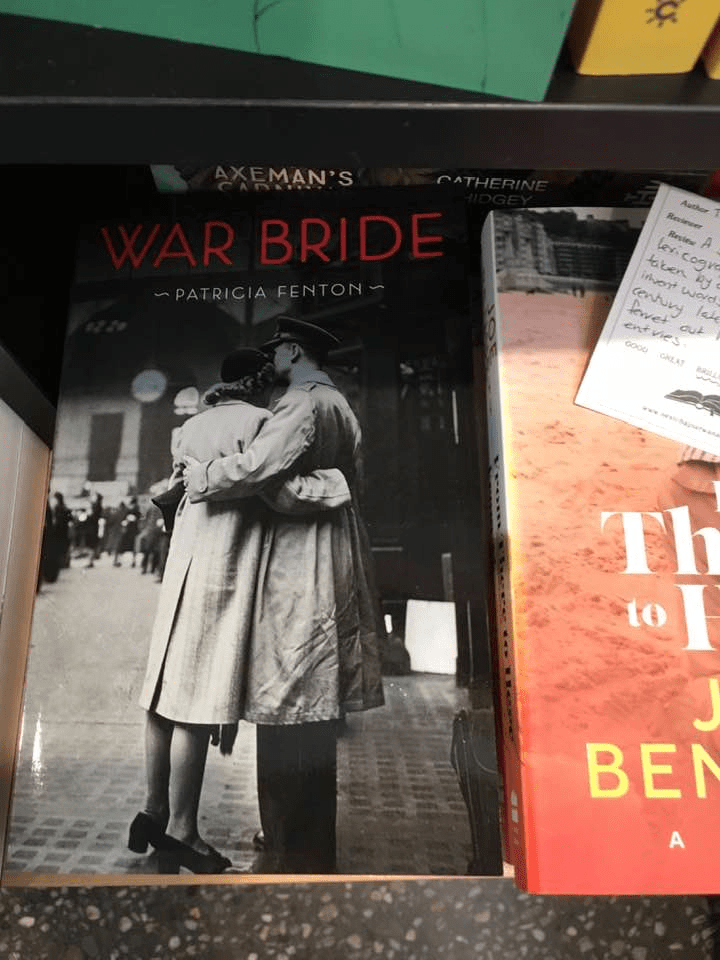
It’s been a long time coming, but War Bride is finally out there. Zana Bell spotted it in Wanaka!
War Bride, Fenton’s debut novel for Heritage Press, is the very readable, engaging, uplifting, and carefully researched story of Evie and Frank, two young people who fall in love against the background of Britain during World War Two. I’m not letting the cat out of the bag by saying that the love story ends with Frank and Evie married, and Evie on her way to a new life as the wife of a soldier from New Zealand who will be returning home with his bride.
Evie is a girl from the Welsh valleys who gets her first job as a housemaid when she is fourteen and Frank is a boy from the Bay of Plenty in New Zealand who also starts work at fourteen. Frank’s first job is in the family’s saw milling business. Evie and Frank’s lives are very different in geography and culture but both families are hard up, still feeling the effects of the Great Depression. Both Evie and Frank have had to grow up quickly.
When the story starts Evie and her family are living in the Vale of Glamorgan, barely getting by. Fenton’s descriptions of the hand-me-down clothes Evie wore, the things the family eats and how desperate they are for the two shillings a week Evie earns, are one of the stand out achievements of the novel. Fenton is the next generation from Evie and Frank, and she does not come from Wales, but she makes the reader feel as if she knows Evie’s life intimately and personally. Fenton’s evocation of Frank’s life as a boy working in forestry and living a rough physically demanding and dangerous life with other men is equally well brought to life. Fenton’s use of slang from the period is another treat for the reader. I could often hear my older male relatives talking when I listened to Frank and his friends. The novel has very obviously been extensively researched, but it wears its research lightly. The period details are specific and authentic, but they never overpower the love story which is the engine of the novel. Rather, the research is the strong base on which the story rests.
The war, as well as bringing fear and peril to everyone, and requiring all the young men to join the armed forces, gives Evie’s family a way to escape from poverty by moving to England to take up war work. For Evie, there is the opportunity for work in a munitions factory and to earn much more than she ever could as a housemaid. For Frank the war means joining the army as a member of the 11th Forestry Company, being taken to Britain, and spending most of the war in Cirencester, cutting and milling trees which were used to prop up bombed buildings so that people could be rescued. It is hard dangerous work, out in all weathers and operating the milling equipment, but Frank has been trained to cope with all this by his earlier life in New Zealand.
With Evie working in the munitions factory and Frank cutting pit props in the forest, the scene is set for them to meet. No courtship runs entirely smoothly and theirs is no exception. Frank falls ill, the Army moves Frank around a bit, bombs fall in London, Evie’s mother thinks that at only eighteen she is too young to marry, and the young couple’s love is tested. But by VE Day, they are a married couple.
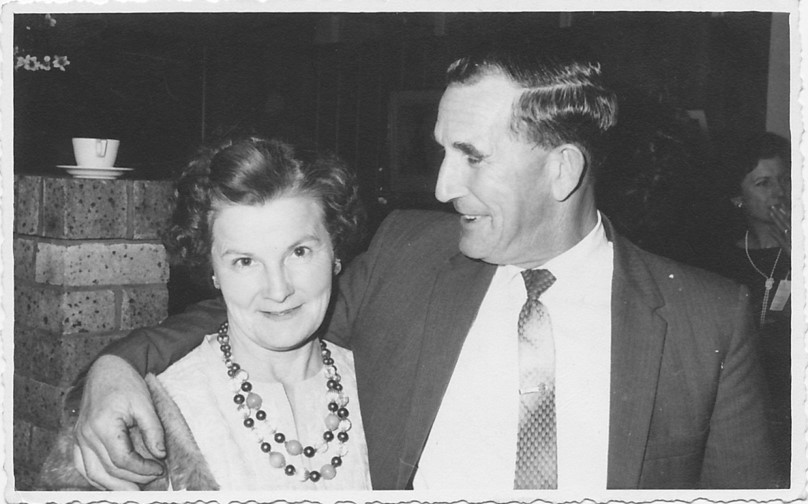
War Bride is dedicated to Prudence and Leonard Fenton, the author’s late parents-in-law, whose story inspired the novel. Many of the events in the novel are based on the stories Pru and Len used to tell, but this is a novel, not a family history. As the author says in her dedication, ‘To the greatest extent possible, I’ve aimed for accuracy and authenticity according to the historical setting, but…it’s a work of fiction’. Evie is a War Bride as the title of the novel tells us. Pru Fenton, the real-life war bride who inspired the story, was one of 3000 brides brought back to New Zealand by New Zealand soldiers returning from Europe and the Pacific.
The obligation to be respectful of the facts of a family story and the need to keep readers interested in a novel is a tricky balance. In my view Fenton has navigated this issue very successfully, making a convincing and beautifully described novel set in rural New Zealand, Wales, Gloucestershire and London, during the time between the late 1930’s and the end of the war in Europe in 1945. This book will be of interest to readers in New Zealand, Wales and England. It will be of particular interest to anyone with a connection to the foresters of the New Zealand Army.
I couldn’t put this book down. Now I’ve finished it, I am hoping Fenton writes a second book to tell the story of the young couple as they leave Britain and start their life in New Zealand.
New Review
Check out this review of War Bride published in FlaxFlower Reviews this week:
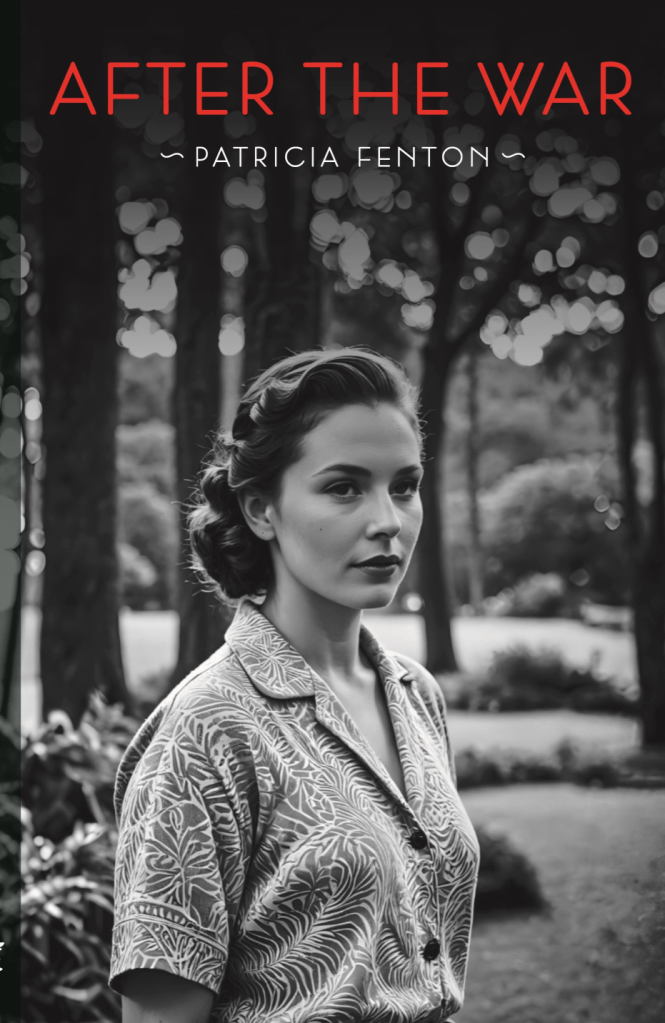
‘From this day forward.’ When Evie uttered those words, they were about day-to-day survival in the midst of a world war. How could she have envisaged the future that lay ahead with her Kiwi soldier after the war? A future of triumph and tragedy, heaven and hell – and hiraeth for her Welsh homeland that would last as long as she lived.
After the War is the sequel to War Bride, published by Heritage Press in 2023.
Here’s what reviewers have said about War Bride:
I couldn’t put this book down. Now I’ve finished it, I am hoping Fenton writes a second book to tell the story of the young couple as they leave Britain and start their life in New Zealand.
LYNN JENNER (WINNER OF THE ADAM FOUNDATION PRIZE IN CREATIVE WRITING)
This is an outstanding story of two ordinary, recognisable and totally familiar people from opposite hemispheres who, but for World War II, would never have met.
The author’s skill in description and depiction of purposes and occurrences reveal an outstanding grasp of people and their motivations.
“I found Beyond the Rimu Grove fascinating. I loved all the small mentions of music, fashion, furnishings etc to create the era. It also lifted a veil on the times which can be presented as clean-cut but of course people are people.
This feels very authentic. I couldn’t believe how much you managed to pack in. Thoroughly enjoyed it.”
Zana Bell (Dr) Author of: Fool’s Gold, Close to the Wind, Forbidden Frontier, The Tides of Time
I’ve uploaded Beyond the Rimu Grove to Smashwords publishing and distribution platform. It’s been accepted into the Smashwords Premium Catalog and is available from Barnes and Noble as well as other retailers including Apple Books, Kobo, Tolino, and from libraries through Smashwords Library Direct service.
Here I am in Abercanaid, South Wales (Near Merthyr Tydfil) researching the life of my late mother-in-law, Prudence Ashfield Price, in preparation for my new novel. (Working title: War Bride). Needless to say, it’s based on her experiences of meeting and marrying a Kiwi soldier and being transported to a new life on the other side of the world. So brave of the little Welsh girl from the Valleys who moved with her family to Cirencester during World War Two, worked in a munitions factory and fell in love with a Kiwi.
Since returning home from the UK, I’m underway with my writing and loving re-creating all that I encountered in the countryside, in museums like St Fagans, in books I found in Waterstones and most of all, through conversations with locals who share a passion for history.
It’s 1966 and the young ones are railing against the stifling, hypocritical values of the times.
With two years teacher training under her belt, Ellen Rose McTavish is sent to Ngarimu Valley School as a Probationary Assistant.
In the isolated farming community, her vulnerability draws in a strong support network, but not everyone is supportive and nothing in the Valley is quite the way it seems.
Devastated by emotional conflict, Ellie contemplates abandoning her teaching career. In a risky liaison, she finds the strength to carry on, oblivious to the impact her year in The Valley will have on the rest of her life.
Delighted with Jodi Bryant’s article about my writing





 Lit Links